The Real Cost of Skipping Move-Out Repairs
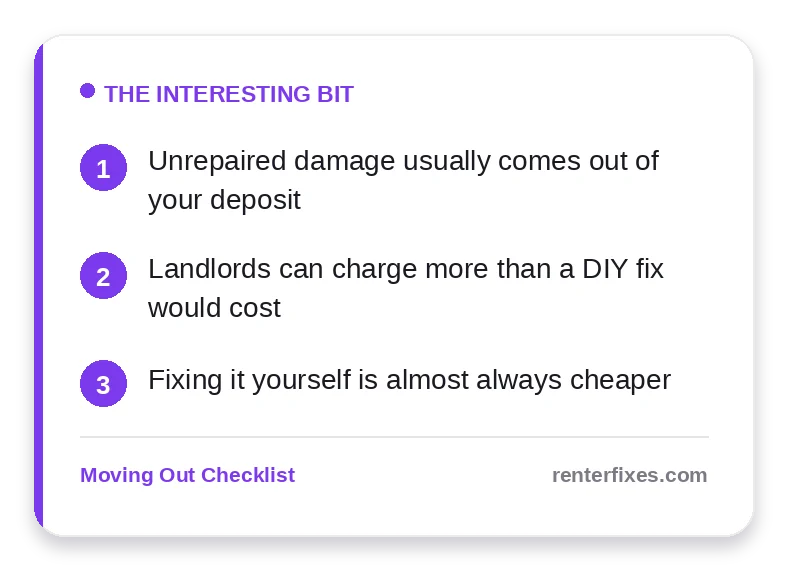
Every repair you skip before moving out becomes a charge on your deposit statement, billed at professional contractor or cleaning service rates rather than the DIY cost of fixing it yourself. This markup is significant: a wall hole that costs three dollars to fix yourself gets billed at seventy-five to one hundred fifty dollars when a handyman handles it. A carpet stain you could treat with a twelve-dollar product gets billed as a professional cleaning or partial replacement. Understanding the actual cost differential is motivating for renters who are tempted to leave repairs for the landlord.

The Deposit Is the First Loss
Security deposits exist precisely for this purpose. Your landlord will deduct every legitimate chargeable item from the deposit before returning anything to you. Multiple unaddressed repairs can easily consume an entire month deposit. In markets where deposits are two months rent, leaving significant repairs undone can result in zero return on a substantial amount of money you have been holding with your landlord for the duration of your tenancy.
You Can Be Billed Beyond the Deposit
In most states, if the cost of repairs and cleaning exceeds your security deposit, your landlord can pursue you for the difference through small claims court or collections. This is not hypothetical: significant damage (damaged hardwood requiring refinishing or replacement, carpet replacement, extensive cleaning) can exceed a standard deposit amount. Leaving these issues unaddressed exposes you to financial liability beyond just losing the deposit.
Moving Out Soon?
Get our free room-by-room move-out checklist and keep your deposit.
See the Checklist →Rental History and Future Applications
A move-out with disputed charges and unpaid deductions can appear on tenant screening reports and credit reports, making it harder to qualify for your next rental. Landlords check these reports during the application process, and a record of disputed move-out charges signals risk to a prospective landlord. The reputational cost of a poor move-out extends beyond just the current deposit.
The Math Is Simple
A comprehensive DIY repair and cleaning supply kit for a typical apartment costs thirty to sixty dollars and takes four to eight hours of effort spread over several weeks. The average security deposit is one thousand to two thousand dollars. The return on investment for that repair and cleaning effort is enormous. There is almost no scenario where leaving repairs undone is financially rational.
Start your move-out repairs now with the right supplies: complete move-out repair kit on Amazon.
More help: Moving Out Checklist guides
What Skipping Repairs Actually Costs You
It is tempting to leave minor damage unrepaired and hope the deposit absorbs it, but understanding how landlords actually bill for unfixed items usually changes that calculation, because the cost on the itemized statement is almost always far higher than what the repair would have cost you. The reason is labor: landlords charge for contractor or handyman time at market rates, so a job that would cost you a few dollars in materials becomes a line item many times larger when someone is paid to do it.
A nail hole illustrates the gap starkly. A tub of spackle and a few minutes of your time costs almost nothing, but a landlord billing an hour of labor plus materials to patch and paint a wall can charge dozens of dollars or more, and several holes multiply that. The same pattern holds across categories: a stain you could have treated, a burn you could have plugged, a fixture you could have cleaned, all become marked-up charges when handed to a paid worker.
Beyond the direct cost, leaving things unfixed can have ripple effects on your deposit. An apartment that clearly was not cleaned or maintained invites closer scrutiny and a less generous interpretation of every borderline item, so the unrepaired damage can cost you more than its own line by souring the landlord’s overall assessment. And if the total damage exceeds your deposit, you can be billed for the difference, turning a skipped repair into an out-of-pocket expense rather than just a lost portion of the deposit.
The practical lesson is to weigh each repair honestly. For things you can fix well with cheap materials and a little time, doing it yourself nearly always beats accepting the marked-up deduction. For damage genuinely beyond your skill, disclosing it to the landlord and negotiating a fair, materials-based cost is better than a surprise contractor invoice. The only items worth leaving alone are those that are truly normal wear and tear, which the landlord cannot legally charge for in the first place, so do not waste effort or risk creating damage chasing those.
What Skipping Repairs Really Costs
Leaving damage for the landlord almost never works out in your favor, because they bill at contractor rates and add their own markup. A nail hole you could fill for pennies becomes part of a minimum repair charge, and a scuffed wall you could wipe clean turns into a full repaint deduction.
There is also a paper-trail risk. Once a landlord itemizes work against your deposit, the burden shifts to you to dispute it, and unrepaired damage is hard to argue. Doing the small fixes yourself before handover keeps the math in your hands and removes the easy line items a landlord would otherwise reach for.
Frequently Asked Questions
What happens if I do not fix things before move-out?
Unrepaired damage usually comes out of your deposit.
Is it cheaper to leave it?
No, landlords often charge more than a DIY fix would cost.
What should I prioritize?
Anything that clearly counts as damage rather than wear.
Related reading
- How to Do a Move-Out Walkthrough Before Your Landlord Does
- Best Products to Clean Baseboards Before Move-Out
- How to Deep Clean an Apartment Before Move-Out (Room by Room)
- How to Get Furniture Dents Out of Carpet Before Move-Out
Official guidance & resources
Want to dig deeper? These trusted, independent resources are worth a read before you start:
- USA.gov — Tenant Rights — How to handle landlord disputes and deposit issues