The Mistakes That Get Renters Charged
Most security deposit losses come from a handful of predictable mistakes. None of them are complicated to avoid. Knowing what they are lets you sidestep every one of them before your landlord ever walks through the door.

Mistake 1: Waiting Too Long to Start
Starting repairs and cleaning the weekend before move-out is the most common mistake. You run out of time, skip things, and do a rushed job. Start three to four weeks out and work through a checklist. This turns a stressful weekend into a manageable project spread over evenings and weekends.
Mistake 2: Not Patching Wall Holes
Nail holes and anchor holes are the most common deposit deduction after cleaning. Every hole you patch yourself costs under a dollar. Every hole you leave gets billed at contractor rates. Spackle, sand, and touch up with matching paint before move-out day.
Moving Out Soon?
Get our free room-by-room move-out checklist and keep your deposit.
See the Checklist →Mistake 3: Skipping the Deep Clean
Surface cleaning is not enough. Landlords open the oven, check under the fridge, inspect cabinet interiors, and look at grout lines. A professional-level deep clean takes four to six hours for a standard apartment but saves you the cleaning fee deduction, which is often $150 to $300.
Mistake 4: No Documentation
Leaving without photographing the unit is the single biggest unforced error renters make. If your landlord claims damage you did not cause, you have no defense without photos. Spend 20 minutes on move-out day photographing every room and send the photos to your landlord by email immediately.
Mistake 5: Not Knowing Your State’s Law
Landlords have a legally required deadline to return your deposit. If they miss it, you may be entitled to the full amount regardless of condition. Renters who do not know this get shortchanged. Look up your state’s deposit return law before move-out day.
Mistake 6: Leaving Items Behind
Anything left behind after your official move-out date can be treated as abandoned property and disposed of at your expense. Remove every personal item, bag of trash, and piece of furniture before handing over keys.
Avoid all these mistakes with the right supplies on hand: move-out prep supplies on Amazon.
More help: Moving Out Checklist guides
The Move-Out Mistakes That Quietly Cost You
Many renters lose part of their deposit not to dramatic damage but to a handful of avoidable mistakes, and knowing the common ones lets you sidestep them. The most expensive mistake is skipping documentation. Without move-in and move-out photos, you have no way to prove the condition of the unit, which means a landlord’s word stands unchallenged and pre-existing flaws can be charged to you. Failing to photograph the apartment, at both ends of the tenancy, undermines every other protection you have.
Cleaning mistakes are the next big category. Cleaning before you have fully moved out, so furniture hides areas and you re-dirty floors hauling boxes, leaves the unit looking half-done. Skipping the high-scrutiny spots, the oven, behind appliances, baseboards, and window tracks, invites cleaning deductions even when the visible surfaces look fine. And leaving any belongings or trash behind can trigger removal and disposal charges that are entirely avoidable.
Procedural slip-ups cost renters who did everything else right. Missing the written-notice requirement in the lease, or giving notice too late, can itself justify charges or extra rent. Forgetting to provide a forwarding address means the deposit and itemized statement have nowhere to go. Not knowing your state’s deposit-return deadline leaves you unable to tell when the landlord is out of compliance. And failing to return all keys, fobs, and remotes can generate replacement fees.
The final cluster of mistakes involves how you handle damage and disputes. Trying to hide damage with mismatched paint or a sloppy cover-up usually reads worse than the original problem and erodes the landlord’s goodwill on borderline items. Painting over a water stain without sealing it, or rushing repairs so patches crack or flash, creates new flaws. And accepting an unjustified deduction without question, rather than requesting an itemization and contesting it with your documentation, leaves money on the table. Avoiding these predictable errors protects far more deposit money than any single repair, because each one is a self-inflicted deduction you have full control over.
Most of these mistakes share a single root, which is leaving everything to the final day. Documentation, repairs that need drying time, a thorough clean of an empty unit, and proper notice all require lead time, and a rushed exit is where the avoidable errors cluster. Starting the move-out process a few weeks out, rather than the night before, is the simplest way to sidestep nearly the entire list, because almost every costly mistake here traces back to running out of time to do it right.
The Mistake That Costs Renters the Most
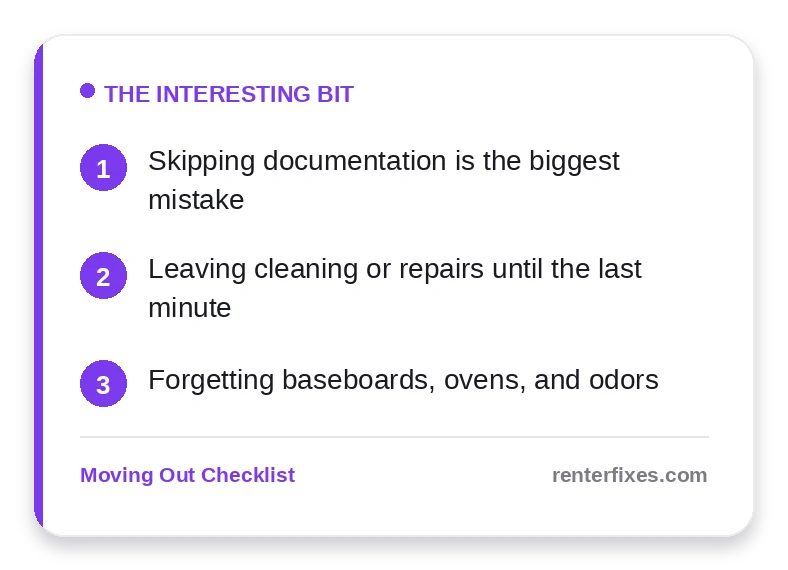
Of all the move-out errors, skipping documentation is the one that turns a small dispute into a lost deposit. Renters who cannot prove the condition they left the unit in have no answer when a landlord itemizes charges, and verbal assurances from a property manager rarely hold up if the relationship sours.
The second avoidable mistake is leaving repairs for the last day. Spackle needs time to dry and sand, paint needs to cure, and a rushed patch looks worse than the original hole. Start the visible fixes a week out so you are not painting over wet filler an hour before you hand back the keys.
Frequently Asked Questions
What move-out mistakes cost renters their deposit?
Skipping documentation and leaving repairs and cleaning until the last minute.
What gets forgotten?
Baseboards, ovens, and lingering odors.
How do I avoid them?
Use a checklist and document everything.
Related reading
- The Renter’s 30-Day Move-Out Countdown Plan
- The Ultimate Renter Move-Out Checklist (Room by Room)
- How to Fix Scuffed and Scratched Rental Floors Without Losing Your Deposit
- How to Hire a Move-Out Cleaning Service (And What It Costs)
Sources & further reading
A few reputable resources that back up the steps above:
- USA.gov — Tenant Rights — How to handle landlord disputes and deposit issues