
Thirty days is the sweet spot for a move-out plan: long enough that repairs, cleaning, and packing never collide, short enough that you are not living out of boxes for two months. Start the countdown on day one of your notice period and work through four clear phases so nothing gets rushed at the end.

Days 30–21: Notify, Plan, and Stock Up
Send your written move-out notice if you have not already, confirm your exact date, and reread your lease for anything specific it requires, like a professional carpet-cleaning receipt. Book movers or a truck now while dates are still open. Buy your repair and cleaning supplies early — spackle, primer, touch-up paint, caulk, and stain remover — so you can start the moment you are ready instead of waiting on a delivery.
Moving Out Soon?
Get our free room-by-room move-out checklist and keep your deposit.
See the Checklist →Days 20–14: Make Every Repair
Fill and sand wall holes, re-caulk the bathroom and let it cure, treat carpet stains, and fix or replace any broken hardware. Doing repairs mid-countdown rather than at the last minute means patches have time to fully dry and you can catch and fix any that shrank before you run out of days.
Days 13–7: Pack and Deep Clean
As rooms empty, deep clean them in order: kitchen and bathroom first since they take the longest, then bedrooms and living areas. Clean the oven, fridge, cabinets, and bathroom fixtures thoroughly, and get the baseboards and window tracks while you are at it. By day 7 the unit should be clean except for the last touch-ups that need furniture gone.
Final 6 Days: Empty, Finish, and Document
Clean behind and under furniture as it leaves, do a final carpet vacuum once everything is out, and wipe down the empty walls. Replace burnt-out bulbs and gather every key, fob, and remote into one place so none gets accidentally packed. Build in a one-day buffer if your schedule allows it; a repair that did not dry in time or a spot you missed is far less stressful with a spare day than with a hard deadline bearing down. Reserve that buffer, or the very last day, for a self-walkthrough against your own checklist and move-in photos, then take your dated, empty-unit photos before you hand back the keys.
Get all your supplies for the 30-day plan in one shot: move-out prep kit on Amazon.
More help: Moving Out Checklist guides
Common Ways a 30-Day Plan Slips
The most common failure is treating the countdown as a suggestion instead of a schedule with real dependencies. Notice has to go out early because everything else follows from your actual move date. Repairs need drying time, so cramming them into the final week means patches are still curing when you need to paint over them. Deep cleaning only makes sense once the apartment is empty, so doing it early just means redoing it later once furniture leaves marks and dust behind. Respecting that order, rather than working on whatever feels most urgent that day, is what keeps a thirty-day window from collapsing into a two-day scramble.
The other common slip is skipping the buffer day entirely. Movers run late, a repair does not dry in time, or you discover a spot you missed only once the light changes in the afternoon. A single day held in reserve, ideally right before your final walkthrough, absorbs almost any single surprise without forcing you to choose between a rushed job and a missed deadline.
Frequently Asked Questions
How do I plan a 30-day move-out?
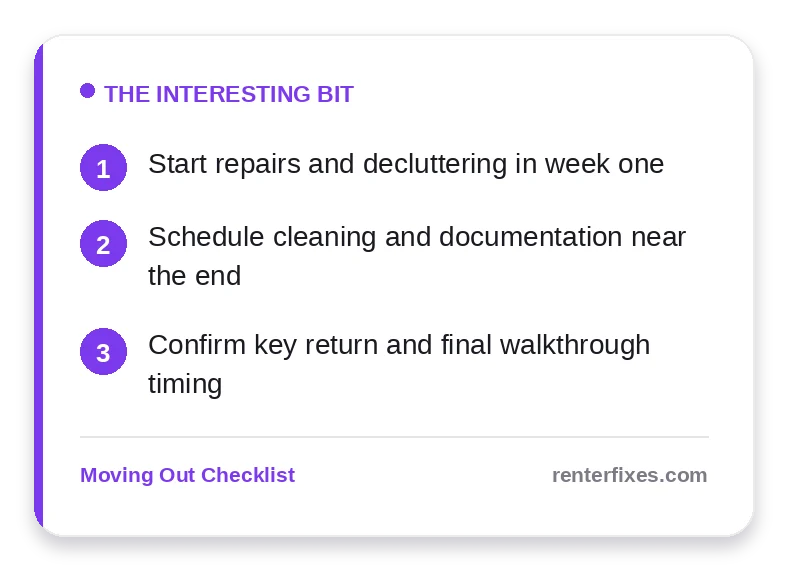
Repairs and decluttering first, then cleaning and documentation near the end.
When do I clean?
In the final days, after repairs are done.
What about logistics?
Confirm key return and the final walkthrough timing.
Related reading
- Renter Move-Out Mistakes That Cost You Your Deposit
- The Ultimate Renter Move-Out Checklist (Room by Room)
- How to Hire a Move-Out Cleaning Service (And What It Costs)
- How to Take Move-Out Photos That Actually Protect You
Helpful resources for renters
Related official resources:
- HUD — Rental Assistance & Tenant Rights — Tenant rights and rental-assistance guidance by state