
Why a Room-by-Room Checklist Beats Guessing
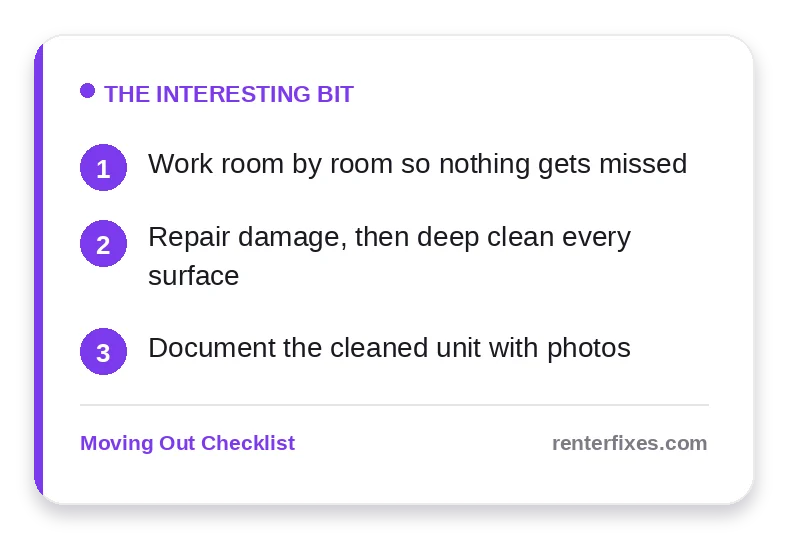
Most renters lose part of their deposit not because they failed to clean or make repairs, but because they missed specific items that landlords consistently check. A systematic room-by-room checklist prevents these misses. Working through each room methodically, rather than cleaning by task type across the whole apartment, means you complete each space fully before moving on and nothing falls through the cracks. This checklist covers everything landlords actually look at, organized by room.

Kitchen Checklist
The kitchen is the most time-intensive room and is inspected most carefully. Check off: oven interior and door glass cleaned, oven racks cleaned or replaced, stovetop burners and grates cleaned, range hood and grease filter cleaned, refrigerator interior and exterior cleaned, dishwasher filter and door seal cleaned, all cabinet interiors and exteriors wiped, countertops and backsplash cleaned, sink and garbage disposal cleaned and odor-free, under-sink cabinet checked for leaks and cleaned, all cabinet knobs and handles cleaned, floor mopped including under appliances.
Bathroom Checklist
Check off: toilet interior, exterior, base, and behind toilet cleaned, toilet seat replaced or cleaned thoroughly, tub and shower scrubbed including grout lines, caulk lines inspected and replaced if moldy, shower head descaled, bathroom sink and faucet cleaned, mirror polished, all cabinet interiors wiped, towel bars and toilet paper holder secure, exhaust fan cover cleaned, floor scrubbed including grout, baseboards wiped.
Moving Out Soon?
Get our free room-by-room move-out checklist and keep your deposit.
See the Checklist →Bedrooms and Living Areas
Check off: all nail and anchor holes patched and painted, wall scuffs cleaned or touched up, carpet vacuumed and stains treated, baseboards wiped, window sills and tracks cleaned, blinds or curtain hardware cleaned, closet interior vacuumed and shelves wiped, ceiling fan blades dusted if present, light fixtures cleaned and bulbs replaced, outlet and switch covers checked and replaced if cracked.
Final Walkthrough Items
Before handing over keys, confirm: all light switches and outlets functioning, all doors and windows opening and closing properly, all keys and access devices collected, garbage removed from all rooms and exterior trash, no personal items remaining anywhere in the unit. Photograph every room after completion. Send photos and a move-out letter to your landlord by email on move-out day.
Get the cleaning and repair supplies to complete this checklist: move-out supply kit on Amazon.
More help: Moving Out Checklist guides
Turning a Checklist Into an Efficient Plan of Attack
A room-by-room move-out checklist is only useful if you work it in a smart order, because doing tasks in the wrong sequence means redoing them. The overarching rule is to clean and repair after the apartment is empty, not before. An empty room lets you reach the corners, closets, and baseboards that furniture hides, and it prevents the frustration of cleaning a floor only to scuff it while hauling boxes out the next day.
Within the checklist, separate the work into repairs, deep cleaning, and final touches, and do them in that order. Repairs come first because spackle, caulk, and paint all need drying time; a hole you fill in the morning is ready to sand and paint by afternoon, but only if you started early. Batch the repairs across the whole apartment in one pass so all the patches cure together while you move on to cleaning, rather than waiting on each room individually.
Deep cleaning follows the same top-to-bottom logic in every room: ceilings and high surfaces, then walls and fixtures, then counters and furniture spots, and floors dead last. This way the dust and debris you knock down always lands on a surface you have not yet cleaned. Kitchens and bathrooms take the most time and benefit from soaking the oven, tub, and toilet with cleaner while you handle drier tasks elsewhere.
Build the schedule backward from your move-out date. Big, drying-dependent jobs and any repairs go earlier in the final week, while quick final touches, a last vacuum, wiping down surfaces one more time, taking out the trash, fit the last day. Reserve time at the very end to walk the apartment with your own copy of the checklist, comparing each room to your move-in documentation, so you catch anything missed while there is still time to fix it before the landlord arrives.
Build the schedule backward from your move-out date so the drying-dependent jobs land early enough. Repairs and anything involving spackle, caulk, or paint go in the first part of the final week, deep cleaning follows once the apartment is empty, and quick final touches fit the last day. Reserve time at the very end for a self-walkthrough against this checklist and your move-in photos, so you catch any missed item while there is still time to fix it rather than discovering it during the landlord’s inspection.
How to Use This Checklist Without Burning Out
The fastest way to lose momentum is to treat move-out as one giant chore. Instead, work the checklist one room per session over the final week, finishing each space completely before moving on. Repairs first, then a top-to-bottom clean, then a final photo of the empty room. That order keeps you from cleaning a wall you are about to patch and sand.
Knock out the high-impact items early: nail holes, scuffs, and anything that obviously reads as damage. Those are the deductions landlords flag first. Save easy wins like wiping switch plates and vacuuming for the last day, when the apartment is empty and you can move quickly without working around furniture.
Frequently Asked Questions
What goes on a move-out checklist?
Repairs, deep cleaning, and documentation, handled room by room.
Where do I start?
Start with repairs, then clean, then photograph the unit.
How early should I begin?
A few weeks out, leaving the final clean for last.
Related reading
- Renter Move-Out Mistakes That Cost You Your Deposit
- The Renter’s 30-Day Move-Out Countdown Plan
- Move-Out Cleaning Checklist: What Landlords Want Spotless
- How to Deep Clean an Apartment Before Move-Out (Room by Room)
Further reading
Related official resources:
- HUD — Rental Assistance & Tenant Rights — Tenant rights and rental-assistance guidance by state