
Toilet Seat Replacement: Cheap, Fast, High Impact
A cracked, discolored, loose, or broken toilet seat is one of the easiest and highest-impact fixes you can make before move-out. Landlords notice the toilet seat immediately because it is at eye level during inspection and its condition is an immediate indicator of how well the bathroom was maintained. A brand-new toilet seat costs ten to twenty dollars and takes ten minutes to install. This repair has one of the best deposit-protection returns on investment of anything you can do.

Measuring and Selecting a Replacement
Toilet seats come in two standard shapes: round and elongated. Measure the toilet bowl from the front edge to the center of the mounting holes at the back, then measure the width at the widest point. A round bowl measures about 16 to 17 inches from the front to the mounting holes. An elongated bowl measures about 18 to 19 inches. Most hardware stores and home improvement centers carry both shapes. Bring the measurements with you, or simply describe the toilet shape as round or elongated. Standard white is the safest color choice for a rental to match typical landlord specs.
Removing the Old Seat
Lift the plastic hinge caps at the back of the toilet seat to expose the hinge bolts. The bolts are typically plastic or stainless and connect through the toilet bowl to nuts underneath. Hold the bolt on top with one hand and turn the nut underneath counterclockwise with the other to loosen. For corroded metal nuts that will not budge, a nut splitter or penetrating lubricant allowed to soak for an hour usually frees them. Once both nuts are removed, lift the seat and hinge assembly straight up and off.
Moving Out Soon?
Get our free room-by-room move-out checklist and keep your deposit.
See the Checklist →Installing the New Seat
Position the new seat hinges over the mounting holes. Insert the bolts through the hinges and the mounting holes and hand-tighten the nuts from below. Once the seat is properly positioned and centered on the bowl, tighten the nuts firmly but not excessively. Plastic mounting hardware is sufficient for normal use but will crack if overtightened. Snap the hinge caps closed over the bolt heads. Open and close the seat several times to confirm it is properly seated and stable.
Additional Check
While you have the toilet area accessible, clean thoroughly around the base, the hinges, and behind the toilet. This is one of the areas of the bathroom most commonly cited for inadequate cleaning at move-out, and accessing it is much easier before the new seat is installed.
Find replacement toilet seats in standard and elongated sizes: toilet seat replacements on Amazon.
More help: Appliances and Plumbing guides
Responding Safely to a Leaking Ceiling
A leak coming through the ceiling is one of the few rental problems where your job is mostly to limit damage and report fast rather than to repair, because the source is almost always inside the building structure, a unit above, the roof, or a pipe in the ceiling, all of which are the landlord’s responsibility. Acting quickly protects your belongings and prevents a small leak from becoming a costly water-damage claim that drags you into a dispute.
The moment you notice water, move your possessions out of the way and put down a bucket or large container to catch the drips. If the ceiling is bulging or sagging with a pocket of trapped water, that water can come down all at once and bring drywall with it. Counterintuitively, the safer move is often to relieve the pressure deliberately: place a bucket underneath and pierce the lowest point of the bulge with a screwdriver to let the water drain in a controlled stream rather than letting the ceiling collapse.
If the leak is near light fixtures or electrical outlets, treat it as an electrical hazard. Water and electricity together are dangerous, so avoid touching wet fixtures, and if water is coming through or near a ceiling light, shut off the power to that area at the breaker. Do not use the affected lights until the leak is resolved and everything is dry. Your safety comes before any concern about the ceiling itself.
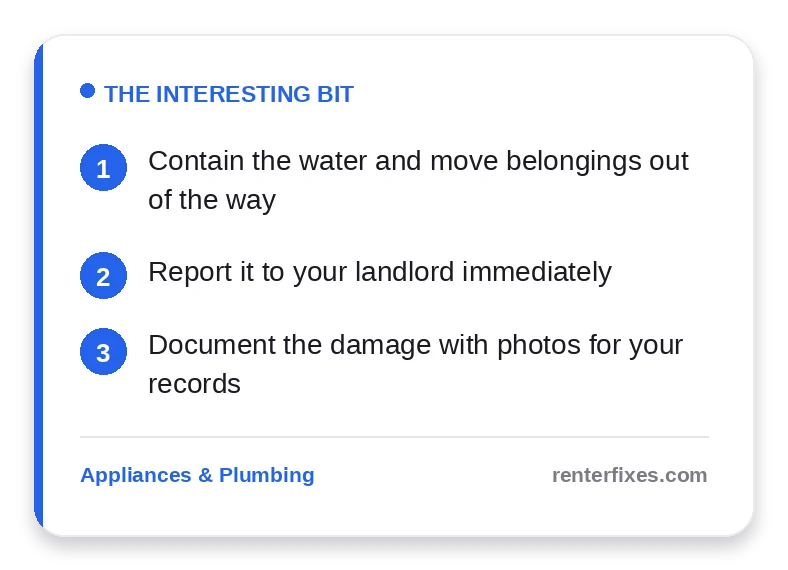
Contact your landlord or emergency maintenance immediately, because the longer the source runs, the more damage accumulates and the more likely mold becomes. Document everything with photos and video of the leak, the water, and any damage to your belongings, both to support the repair request and to protect your own claim if your possessions are harmed. Note the date and time you reported it. A leaking ceiling is not a tenant repair, but a tenant who responds quickly and documents thoroughly is far better positioned than one who waits and hopes it stops.
Act Now, Then Document Everything
A leaking ceiling is an emergency you should respond to before you worry about blame. Move belongings out of the way, put a bucket under the drip, and if the bulge is holding water, pierce it with a small hole to release the pressure so the ceiling does not collapse. Then shut off water to the area if you can identify the source.
This is almost always the landlord’s repair, but your protection is documentation. Photograph the leak and any damaged belongings, then report it in writing immediately so there is a timestamped record. Prompt notice shields you from being charged for water damage and strengthens any claim for ruined possessions.
Frequently Asked Questions
What do I do about a leaking ceiling?
Contain the water, move belongings, and report it to your landlord immediately.
Is a ceiling leak my responsibility?
Usually not; it is typically a landlord repair.
Should I document it?
Yes, photograph the damage for your records.
Related reading
- How to Fix Scuffed and Scratched Rental Floors Without Losing Your Deposit
- How to Fix a Running Toilet in Your Rental (No Plumber, No Drama)
- What to Do With Furniture Damage You Caused in a Rental
- How to Make Rental Blinds Look New Again
Sources & further reading
Want to dig deeper? These trusted, independent resources are worth a read before you start:
- USA.gov — Tenant Rights — How to handle landlord disputes and deposit issues
- EPA WaterSense — Water-efficient faucets, showerheads and fixtures