Wall Scuffs Are Easy to Fix If You Know How
Scuffs, smudges, and marks on painted walls are a normal part of living in any space, but they can become deposit deductions at move-out if left unaddressed. The good news is that most wall marks are not permanent damage. They are surface-level issues that respond well to a few simple cleaning approaches. Most scuffs can be completely removed without ever touching a paintbrush, and the ones that cannot are easily covered with a spot of matching paint.
Start with a Magic Eraser
A melamine foam eraser, commonly sold under the brand name Mr. Clean Magic Eraser, removes a surprising range of wall marks without damaging the paint underneath. Dampen the eraser slightly and rub it gently in a circular motion over the scuff. These erasers work through very mild abrasion and are safe on most painted surfaces. Test in an inconspicuous spot first if you are unsure, since they can occasionally dull high-gloss finishes if you rub too aggressively. For standard eggshell or flat paint found in most apartments, they work extremely well.
Cleaning with Dish Soap and Water
For greasy smudges or handprints near light switches and door frames, a small amount of dish soap mixed with warm water is an effective cleaner. Apply with a soft cloth, rub gently, and wipe dry immediately so the wall does not absorb moisture. This works well on semi-gloss paint. Do not use on flat paint finishes since water can damage the surface or leave marks worse than the original smudge.
Moving Out Soon?
Get our free room-by-room move-out checklist and keep your deposit.
See the Checklist →Baking Soda Paste for Stubborn Marks
For stubborn marks that do not respond to a magic eraser, mix a small amount of baking soda with water to form a thick paste. Apply with a soft cloth and rub very gently. Baking soda is mildly abrasive and works on marks that have slightly embedded into the paint surface. Rinse the area with a clean damp cloth afterward and let dry.
When Paint Touch-Up Is Necessary
Some marks, particularly crayon, permanent marker, or paint transfer from furniture, will not come off with cleaning alone. These require paint touch-up. Apply a thin coat of matching paint over the mark with a small brush and feather the edges outward. Let it dry completely before checking whether a second coat is needed. In most cases a single thin coat is sufficient.
High-Traffic Areas to Check
Focus your wall cleaning efforts on the areas that accumulate the most marks: around light switches and outlet covers, along hallways where furniture gets brushed, near doors where handles and hinges create marks, behind where furniture sat against the wall, and around the kitchen and bathroom where splatter and moisture collect. A pass through all of these before your final walkthrough covers the majority of what landlords look at.
Stock up on wall cleaning and touch-up supplies: wall scuff removal supplies on Amazon.
More help: Walls and Patching guides
Getting an Accurate Paint Match Without the Original Can
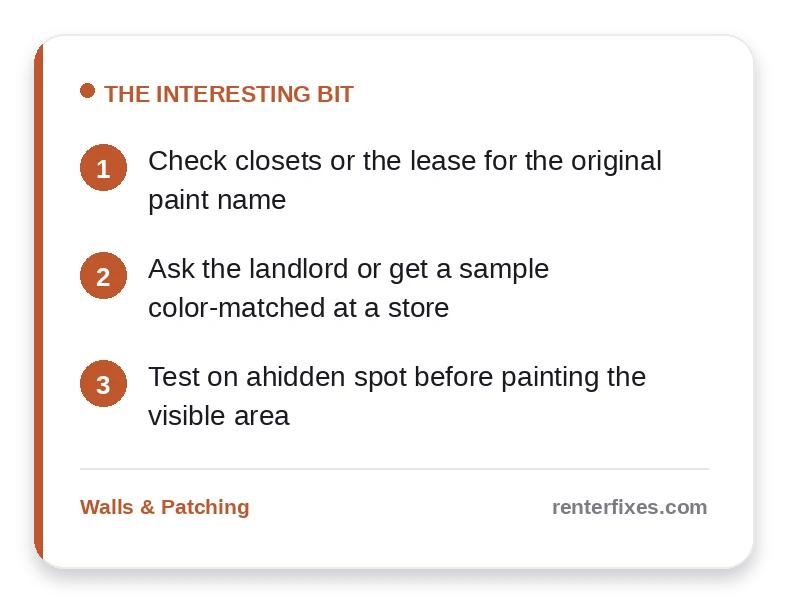
Touch-up paint only disappears if the color is right, and renters rarely have the original can to work from. Your first move is to look for it anyway: landlords and previous tenants often leave leftover paint in a closet, under the kitchen sink, in the basement, or on a storage shelf, sometimes with the color name written on the lid. A quick email to your landlord asking for the wall color and sheen is worth sending, because many property managers keep a standard paint on file for every unit they own.
If no can turns up, take a physical sample to a paint store for a computer match. Most hardware stores can scan a chip with a spectrophotometer and mix a near-exact match in minutes. To get a usable chip without leaving a new bare spot, cut a small flake from an inconspicuous area like behind a door, inside a closet, or below the line where furniture sits. A clean two-inch sample reads far more accurately than a smear of paint on a card, and the store can match both the color and, in many cases, the sheen.
Remember that wall paint ages. Sunlight, kitchen grease, and years of cleaning shift the original color slightly, so a freshly mixed match to the factory formula can still look brighter than the faded wall around it. Always test on a hidden patch and let it dry overnight before committing, because paint changes color as it cures. When the match is close but not perfect, feathering the edges and painting the entire wall corner to corner is more reliable than spotting a single patch in the middle of a large surface.
Sheen matters as much as color when it comes to hiding a touch-up. Most rentals use flat or matte paint on walls precisely because it hides repairs well; a flat finish scatters light and blends patches almost invisibly. If your walls are eggshell, satin, or semi-gloss, a touch-up will catch the light and show as a shiny or dull spot even with a perfect color match, so painting the full wall from corner to corner is often the only way to make the repair truly disappear. Match the original sheen exactly when you buy paint, and note it for future reference.
Frequently Asked Questions
How do I find my rental’s paint color?
Check closets, the lease, or ask your landlord; many keep the paint name on file.
Can a store match it?
Yes, a paint store can color-match a small chip or sample.
How do I avoid a mismatch?
Test on a hidden area first and let it dry, since wet paint looks different.
Related reading
- How to Deodorize a Rental Apartment Fast Before Inspection
- How to Get Smoke Smell Out of a Rental Apartment
- How to Fix Scuffed and Scratched Rental Floors Without Losing Your Deposit
- How to Fix a Running Toilet in Your Rental (No Plumber, No Drama)
Official guidance & resources
Helpful authoritative reading on this topic:
- HUD — Rental Assistance & Tenant Rights — Tenant rights and rental-assistance guidance by state
- USA.gov — Tenant Rights — How to handle landlord disputes and deposit issues
- EPA — Protect Your Family From Lead in Your Home — Lead-paint precautions when sanding or patching pre-1978 walls